







UCT Prague researchers participated in the discovery of a new mechanism for stabilizing retroviral capsids
Prague, 6 October 2026 – An international research team including UCT Prague Professors Michaela Rumlová and Tomáš Ruml has explained a new mechanism by which certain retroviruses stabilize their protective shells, called capsids. Results published in Nature Communications reveal that different groups of retroviruses utilize the same cellular metabolite in distinct ways. Beyond expanding our understanding of the evolutionary diversity of these viruses, these findings could prove useful in the design of stable viral nanoparticles for the targeted delivery of molecules into cells.
“We at UCT Prague were primarily involved in the expert co-leadership of the grant—specifically, in formulating research questions, designing experiments, interpreting results on an ongoing basis, and making decisions regarding next steps in R&D. Our prior experience with retroviral capsids—including HIV-1, M-PMV, and MLV—and the effects of IP6 also played a significant role here, providing a seamless foundation for this new study,” Professor Tomáš Ruml said.
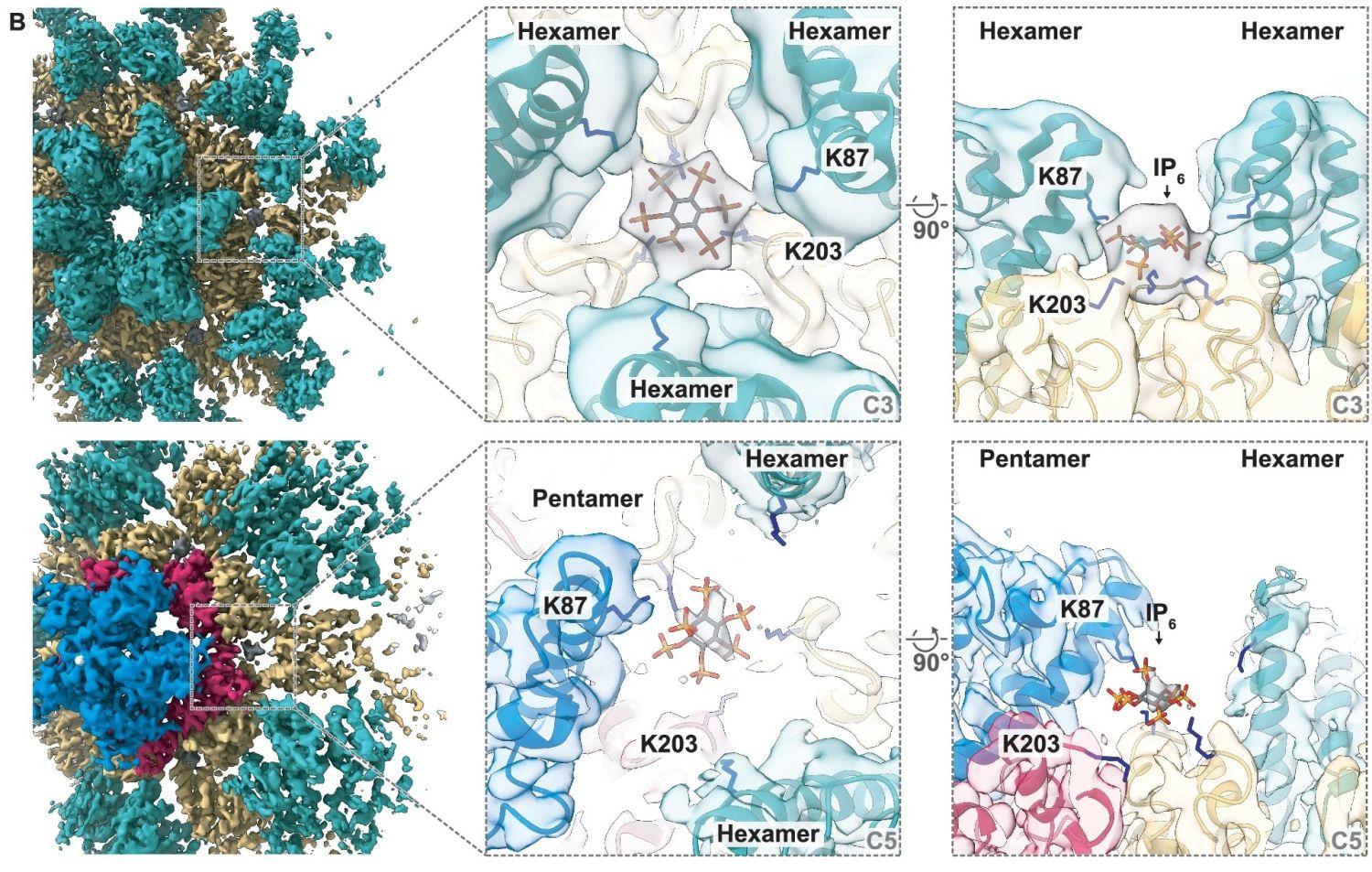
While it was known that HIV-1 utilizes the inositol hexakisphosphate (IP6) cellular metabolite to assemble and stabilize its capsid by binding it within the pores of its structural subunits, this new study employed cryo-electron microscopy to reveal that a different mechanism operates for other groups of retroviruses. Specifically, in the case of the beta-retrovirus Mason-Pfizer Monkey Virus (M-PMV) and the gamma-retrovirus Murine Leukemia Virus (MLV), where IP6 does not bind within the pores of the capsid subunits but rather at the interface between them, the site of the so-called capsid lattice’s threefold axis.
This difference has significant implications for understanding capsid behaviour during the viral life cycle. While HIV-1 is heavily dependent on IP6 as early as the formation of viral particles within a producer cell, the importance of inositol phosphates for M-PMV and MLV became more pronounced after the virus entered the target cell; there, inositol phosphates helped maintain capsid stability and prevented premature disassembly.
This study thus showed that, during evolution, various retroviruses developed distinct ways of utilizing the same cellular metabolite to control the assembly and stability of the capsids.
“This publication marks the culmination of a years-long scientific detective story; our journey took us from quantifying the effect of IP6 on HIV-1 and comparing various retroviruses to discovering a completely new mechanism by which M-PMV and MLV utilize the same cellular metabolite,” Professor Michaela Rumlová explained. “A number of our students and early career researchers, including Alžběta Dostálková, Filip Kaufman, Ivana Křížová, and Barbora Vokatá, contributed to this line of research over the years. It was their work as well that laid the foundation upon which the current study built,” Professor Rumlová added while noting that researchers from Cambridge and the Max Planck Institute also collaborated on the study.
Czech participation in this project was supported by a grant from the Czech National Institute of Virology and Bacteriology’s EXCELES Programme.
Reference
Retroviruses use different IP6 binding mechanisms to alter the properties of their capsids. In: Nature communications.