







I waited two years for a start-up grant and wrote ten versions of my project idea
Anna Vanluchene from UCT Prague’s Department of Chemical Engineering has received a prestigious start-up grant from the Dagmar Procházková Fund. However, she did not receive funding right away. In this interview, she describes how she developed ten versions of her Illuminating Flow project idea (combining photocatalysis with flow reactors for pharmaceutical synthesis). She explains why she considers perseverance to be crucial when applying for grants, how international experience has influenced her approach to team management, and how her research can reduce the chemical industry’s dependence on fossil fuels and imports from China.
What did the Dagmar Procházková Fund grant mean to you?
I consider it to be a great success. It is the first injection of funding that will allow me to ensure full independence for my research endeavour, to start my own research group, and to fund students so I can get started properly.
What have been your previous experiences with grants?
During my doctorate, a cotutelle (international doctorate under dual supervision), I was funded by a grant from the French government. Then I worked at the Academy of Sciences of the Czech Republic (CAS) and received a Marie Skłodowska-Curie Action (MSCA) Postdoctoral Fellowship to go abroad. The idea for my now-funded project was developed about two years ago and, since then, I have gradually developed and adapted the idea for various grant calls. I submitted about ten different versions of the proposal. I did not receive a grant from the Dagmar Procházková Fund last year, but this year, my application was successful.
This probably requires a great deal of patience and perseverance.
Certainly, because the success rates for most grants have been declining for some time. But as a motivational example, I will tell the story of Timothy Noel, a Belgian professor of chemistry living in the Netherlands. He applied for the prestigious European Research Council (ERC) grant, which is among the most sought-after in Europe, seven times. But no failure deterred him and eventually he succeeded and opened the door to potentially massive grant funding. He was already one of the world’s top scientists in the field at that time and openly described his journey on his blog [ref – link at the end of the interview].
What advice does this convey to other grant applicants and early career researchers?
Start early, read a lot, don’t give up, and—most importantly—apply repeatedly. Learn from rejections and overcome possible frustration from failures. Read blogs and books by successful people, where you will find not only the glorious results of their work, but also the hardships they faced over their entire journeys. Of course, building your team and laboratory is impossible without finances. I myself still hope that I will be able to receive even bigger grants in the future.
How has your international experience influenced your scientific approach?
A lot and on several levels. Different laboratories teach you how to do things differently. You gain varied experience about how different institutions function. You see other people’s positive motivations, their ability to be ambitious without negativity, their involvement in institutional matters, their openness to cooperation with companies (e.g., tech transfers, spin-offs). The most important thing is to broaden your horizons. I see going abroad as a necessity. What I have taken away the most is drive, great support, and the idea that scientific output is not just about metrics, but also about dedication to one’s topic.
What is your Illuminating Flow: Transport Phenomena in Photocatalysis about, in layperson’s terms, and how is it unique?
Most of today’s chemical industry is still based on thermal processes and fossil fuels. Photochemistry enables electrification, where the energy source is photons delivered by LEDs, which can generate electricity from renewable sources. Current research focuses mainly on chemical reactions and their mechanisms, but as a chemical engineer, I focus on designing processes and reactors suitable for industrial use. In batch reactors, light fades rapidly with distance from a source, so much of a reaction mixture is not illuminated. Flow reactors solve this problem, but they bring new challenges such as working with solid catalysts and subsequently scaling up production and achieving higher production rates of the desired chemicals at a given scale.
One can imagine a transparent tube with a catalyst on the walls, upon which light shines and through which reactants flow. This project has a unique emphasis on engineering solutions and overall process efficiency.
So, were you inspired by a gap in the market to connect photocatalysis with transport phenomena?
Exactly. I combine my areas of expertise: microfluidics, photocatalytic degradation of organic substances (CAS), and synthesis (MSCA Postdoctoral Fellowship). The idea itself is not new, and pharmaceutical companies are very interested in “greener” photochemistry, but in practice, there is often a lack of appropriate engineering solutions and apparatus for industrial use.
What are the practical applications of your work and what substances are you focusing on?
Mainly on pharmaceuticals and on the synthesis of so-called fine chemicals, which are often the building blocks for the production of pharmaceuticals. There is also a geopolitical dimension to this, i.e. less dependence on imports from China and sustainable synthesis in Europe where it makes economic sense.
And what chemicals are you specifically talking about?
For example, building blocks for advanced synthesis, compounds prepared by trifluoromethylation reactions, or products of oxidation reactions with singlet oxygen. At the same time, we focus on reactions that are, in the classical design process, less safe or technologically demanding, where new approaches, such as photochemistry in flow reactors, could be safer and have better process control. Of course, this is not a universal solution for all types of reactions.
The goal of this project?
I plan to start a fully functional laboratory and research team, create high-quality experimental data on selected molecules and based on them, try to build cooperation with industrial partners. Without data, it is impossible to come to companies with just an idea. Within three years, I would like to have results that can be realistically presented and further developed.
What are the main challenges in transport phenomena during photocatalysis?
The methodology for repeatability of experiments in photochemistry is relatively demanding and there are unforeseen obstacles in building apparatus. Also, the scale-up from microliters to a larger scale.
What methodology will you use, and how big are the microreactors and their flow rates?
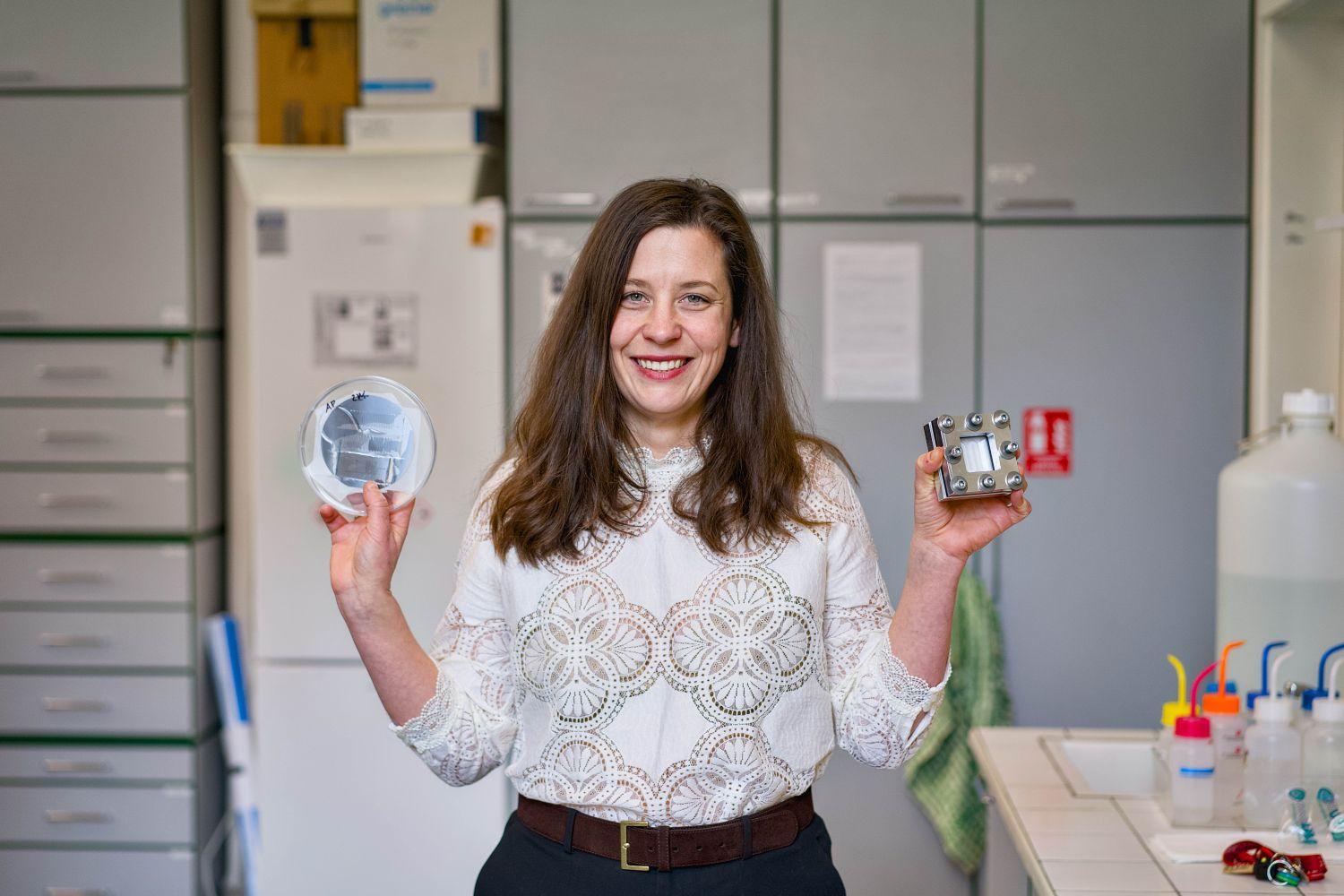
I have two different directions in methodological design. The first direction involves microreactors the size of a laboratory slide. You make a structure using a laser, and then you have to cast it and make a microreactor. This allows you to quickly adjust the geometry of the reactor. This method is, of course, not applicable in the commercial setting, but it is ideal for studying transport phenomena and precise measurements.
The second direction involves reactors that are flow cells. These are already larger, approximately 15 x 15 centimetres, and their flow rates are in the order of millilitres per hour. This is the initial scale that we will further increase during the project.
There is a big difference between a flow rate of microlitres per hour and industrial needs. Will it not work differently in reality?
Our research will focus on studying the phenomena themselves for now, and scaling will be addressed later. In addition, we will combine the experimental data obtained with computer simulations that will help design suitable conditions for a larger scale. For some high-value fine chemicals, these scales, combined with continuous operation or parallelization of reactors, may already be practically usable.
What catalysts will you use and how will you attach them to the reactor walls?
I am focusing on heterogeneous photocatalysis, and we will mainly use graphitic carbon nitride and its more advanced modifications. These are semiconductor materials that can be synthesized relatively easily and are suitable for immobilization on glass reactor walls. A key part of this project is the creation of a stable catalytic layer for long-term flow-through operations. To increase the contact of reactants with the catalyst, we will also consider multiphase modes, for example, gas bubbling, in order to disrupt the otherwise laminar flow.
Why did you choose this field and the Department of Chemical Engineering?
During my postdoc in Belgium, the department had an opening for an Assistant Professor position that caught my attention and I applied for it. I did my undergraduate, graduate, and initial doctoral studies here, and I love the department. I have a Bachelor’s degree in Chemistry.
Are you collaborating with anyone?
We collaborate with BUT Brno focusing on creating layers and immobilizing catalysts on glass, as well as with the Institute of Chemical Process Fundamentals of the Academy of Sciences of the Czech Republic. And as for organic synthesis, we are connected with Ghent University via postdoc internships. At the same time, my colleague Viola Tokárová and I received a Czech Science Foundation grant in cooperation with BUT Brno and Masaryk University, with our part of the project focusing on the use of flow reactors for photochemical reactions and testing the antibacterial properties of photocatalytic materials. And I am writing other grant proposals in which I am trying to build new collaborations.
What does the creation of an independent research group at UCT Prague look like?
I started by renovating the premises that were assigned to me and gradually building my team. It is important for research work to have Ph.D. students; I have already hired one and we will recruit more. In addition to building the group, I will engage in securing further funding for the group, so I will be writing more grant proposals. It is important to think far enough in advance when it comes to prospective funding for a research group.
What type of students are you looking for?
The laboratory and team I are building will be very multidisciplinary, just like the area I am working on. That is why I am looking for students who are attracted to true multidisciplinary research, those who, for example, have knowledge of engineering, but who don’t mind a little bit of pure chemistry. One student in their own right does not have to (and cannot) know every subject, so I will ideally have a team consisting of different people with different research backgrounds. Motivated, DIY-type students who would rather enthusiastically build or invent something themselves than conduct repetitive measurements. Organic or analytical chemists will also find their place here. If this topic is interesting to students in any way, they can definitely contact me. I am also open to interdepartmental cooperation with other UCT Prague Faculties.
How would you describe your path to photocatalysis/chemical engineering?
Studying Chemistry as an undergrad gave me a broad perspective, but I was gradually narrowing my focus and eventually chose engineering. Chemical engineering intrigued me with its logic and was the easiest for me to grasp at the time. But I have always enjoyed working on projects more than the studies themselves. Even during my Bachelor studies, I really enjoyed and was interested in the Professor Štěpánek Group’s projects, where I was doing something completely different than I do now. I only got into photochemistry during my time at CAS and then, during my postdoctoral fellowship, I devoted myself to electrochemistry. My current focus is, thus, a natural interlinking of all these areas. Consequentially, I developed an awareness of the necessity to become independent and return to the department with my own, different research agenda, which, in my opinion, is an important and correct basis for establishing my own research group.
What is the biggest challenge of this project for you?
The transition from being a postdoc to a leadership position is a big change for me and I think it is not talked about enough. It means a shift from my own experimental work to leading a team, planning and delegating tasks, and motivating students. From a practical point of view, one of the main challenges is the transfer of reactions from the microscale to functional systems, the construction of reactors, the immobilization of catalysts, and generally confirming that this direction makes sense in the long term and that it has future potential.
Ref: https://www.noelresearchgroup.com/2022/03/17/my-personal-story-to-obtain-an-erc-grant-7-submissions-4-interviews-and-6-heartbreaks/