







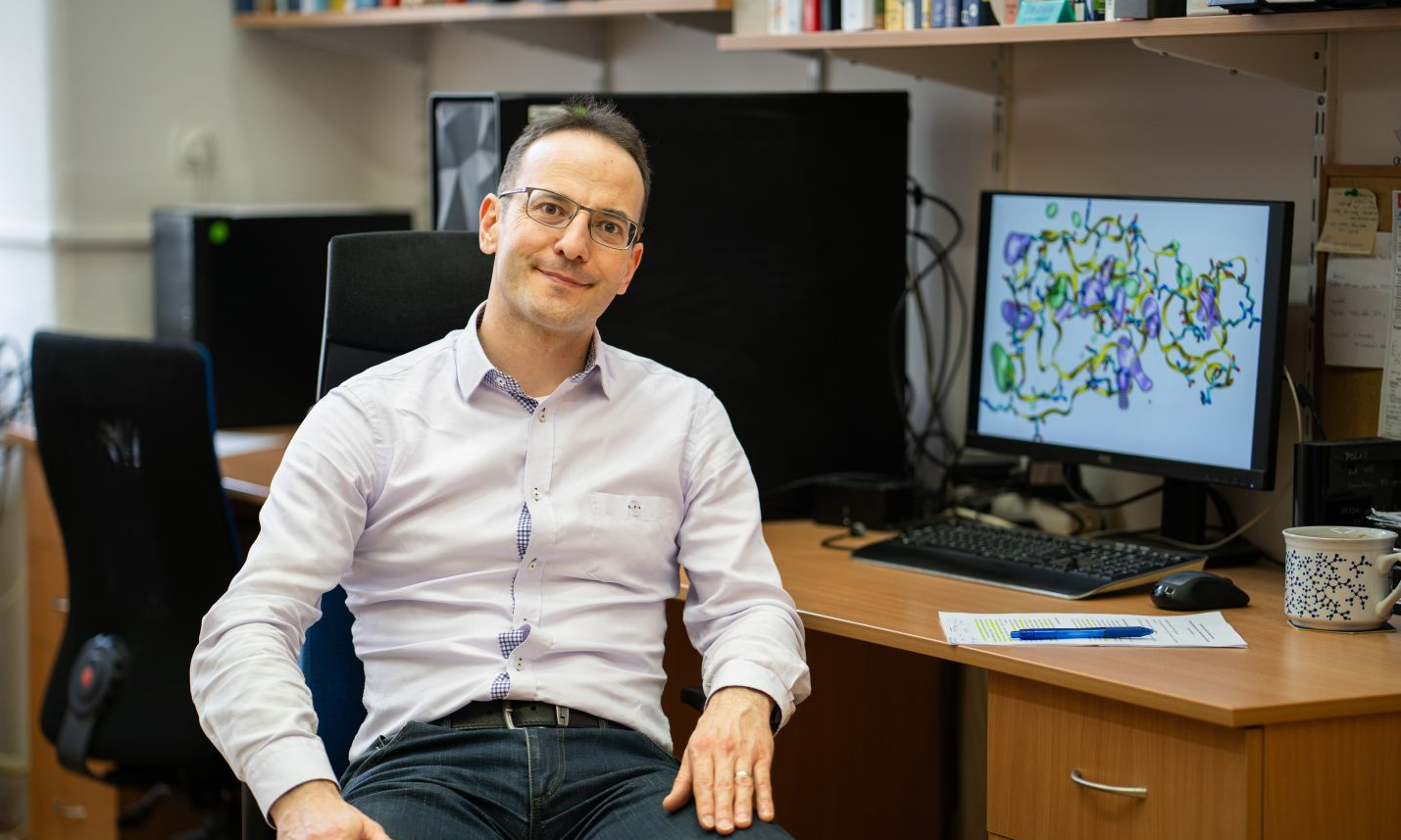
Jan Heyda: Molecular view of membraneless organelles in collaboration with the USA
Assoc. Prof. Jan Heyda from the Department of Physical Chemistry at UCT Prague leads the theoretical part of the project “Membraneless Organelles in Biological Environments”. His group uses molecular dynamics simulations to explore how intrinsically disordered proteins form condensates in cells. Together with Assoc. Prof. M. Vazdar, they systematically study the effects of ions, point mutations in proteins, and membrane composition on the formation, stability, and adsorption of these structures at the atomic level. The goal is to create a predictive map that will lead to better understanding of neurodegenerative diseases and development of smart biomaterials, in close collaboration with experiments by Professor Paul Cremer from Pennsylvania State University.
What is your project about and what are your objectives?
Our project investigates how so-called membraneless organelles (MLOs) arise and function within cells. These are dynamic structures in which the cell temporarily concentrates selected proteins and RNA so that certain processes can proceed more rapidly and efficiently than in the surrounding environment. Unlike classical organelles, such as mitochondria or the nucleus, they are not bounded by a membrane, but arise through the self-organization of biomolecules into a denser phase — a so-called condensate.
In the project, we focus mainly on intrinsically disordered proteins that have the ability to form these condensates, but are also very sensitive to the composition of the solution, small changes in their sequence, and contact with biological membranes. The goal is to understand, at the molecular level, what controls the transition from freely dispersed molecules to a condensed state and when such a state is still functional or may already lead to pathological behaviour.
If the project is successful, what will it bring? How will it help in the fields of medicine or pharmacy?
This is still a basic research project, so its main contribution will be a deeper understanding of the behaviour of proteins in the biological environment. Such knowledge is important for research into neurodegenerative diseases, where certain proteins lose their native behaviour, but also generally for protein biophysics and the development of biomaterials or biotechnological applications. This is not a project that would immediately lead to new treatments, but it can contribute to ensuring that future, more targeted interventions are on a firmer scientific basis.
You lead the theoretical part. What is the nature of the experiments?
The experimental part takes place in Professor Paul Cremer’s group at Pennsylvania State University. His team prepares the polypeptides under study and monitors their behaviour in the presence of salts at various concentrations and/or on membrane surfaces. Using spectroscopic and thermodynamic methods, they determine under what conditions the condensates form, what their composition is, and how stable they are. The advantage of the project is that the experiments and simulations are designed from the outset to describe the same systems.
How did you get involved with the Cremer Group at Pennsylvania State University?
During my doctoral studies with Professor Pavel Jungwirth, I studied how the presence of ions affects the behaviour of biomolecules. Professor Cremer is one of the most prominent figures in this field, and our professional contact gradually developed into a long-term collaboration between experiment and theory. Within the framework of ion-specific effects, we moved from polymers and peptides toward the question of how protein condensates and membraneless organelles can be influenced.
How do the experiments differ from the simulations?
An experiment shows the overall behaviour of a system, but we often cannot directly discern the underlying molecular causes from it. Simulation allows us to look inside and observe which specific molecular interactions lead to this behaviour. In the experiment, thus, we see the result; in the simulation, its details. Each approach has its limits, but it is their combination that allows us to obtain a much more compelling and comprehensive picture than if we used only one of them.
How does the collaboration between the theorist and the experimenter proceed?
In the beginning, it is mostly about finding a common language, especially regarding complex topics. The theorist and the experimentalist view the same problem differently, and it takes some time for both to clarify what is realistic for the other. Once this is achieved, a truly strong collaboration begins to emerge: the experiment helps to anchor the simulations in reality, and the simulations, in turn, provide the experiments with a detailed, physically grounded molecular interpretation.
How did you get into physical chemistry and computer modelling?
I graduated from a mathematics-oriented high school in České Budějovice and enjoyed chemistry, mathematics and physics, so studying physical chemistry was a natural choice for me. I then came to computer simulations through statistical thermodynamics, when I realized that there were few problems that could be solved analytically. On the contrary, computer simulations allow us to assemble even very complicated systems, study them at a microscopic level, and arrive at a mechanistic understanding of key processes. I still enjoy that very much.
What shaped you into the scientist you are today?
Three things were crucial for me: the supportive environment in Professor Pavel Jungwirth’s group, my postdoctoral experience with Professor Dzubiella, and also the diverse collaborations, thanks to which I understood that the best results often arise from a combination of multiple perspectives that complement each other.
What convinced the grant review committee to support your project?
The path to support was not entirely straightforward, but we gradually refined the proposal and strengthened it with preliminary results. I believe the decision was driven by the combination of a timely scientific topic, the strong connection between experiments and simulations, and a long-term collaboration that have already yielded concrete, high-quality results.
Who else are you collaborating with on the project?
On the Czech side, my key collaborator is Associate Professor Mario Vazdar, whose expertise covers the interactions of biomolecules with membranes. Members of our groups and doctoral students are also involved in the project.
How will you disseminate your project outputs?
We will share the results as is standard, in the form of peer-reviewed publications and conference presentations. We plan to make the simulation data available only for selected systems due to their large volume (approx. 10 GB per simulation). For other systems, we will provide the inputs, parameters, and analytical procedures that will allow our results to be reproduced or built upon.
Will you be communicating the results to the wider public?
Yes, definitely. Professional seminars, student theses, and presentations will be a natural part of the project, but we would also be happy to engage in outreach for the wider public.
Are you looking for students for this project? And if so, what kind?
Yes, we are looking for students. The project offers topics for doctoral students focused on computer modelling, as well as for students with an interest in experiments, thermodynamics, biophysics, or biochemistry. The breadth of the topic, the opportunity to work with modern methods, and the connection to international collaboration are all very attractive features.