







Green hydrogen: UCT Prague research team looking for a way to put expensive electrolyzer materials back into circulation
Green hydrogen is a central pillar of the EU’s 2050 climate neutrality policy, but key components for its production, PEM (proton exchange membrane) electrolyzers, rely on extremely rare iridium and problematic perfluorinated polymers. The IRION project, which includes UCT Prague participants Karel Bouzek and Martin Prokop, is investigating possible “extraction” of precious metals and membranes from retired electrolyzers in order to return them back into circulation. This is not just a laboratory experiment; successful recycling of these components could significantly reduce the cost of green hydrogen production, reduce the amount of hazardous waste involved, and become a turning point for the future of the EU Hydrogen Strategy and whether it will remain on paper or become a reality. More in the interview below with Dr. Prokop.
Could you please briefly introduce IRION and explain to us what key PEM electrolyzer-related problem it addresses?
The IRION project focuses on a major problem associated with the disposal and recycling of PEM water electrolyzers, devices used to produce green hydrogen. Production of these devices has risen quickly; they combine well with renewable energy sources and are currently installed in Europe, America, and Asia with megawatt (MW) level outputs. Advantages of PEM electrolyzers include high performance, relatively compact dimensions, and good durability. Recycling after the end of their service lives, however, is a complex process. PEM electrolyzers contain a large amount of perfluorinated sulfonated polymers in their membranes and in the catalytic precious metal layers (platinum catalyst on the cathode and iridium on the anode). During recycling, platinum and iridium must be separated while preventing the degradation of perfluorinated sulfonated polymers during this process. These metals can then be recycled and used to produce new membranes and ionomers for other electrolyzers.
In what way might this project have impact beyond the industrial sector, on society as a whole?
PEM water electrolysis is a key technology involved in the production of green hydrogen in current energy operations and in hydrogen strategies for EU countries. In Europe, PEM electrolyzers are manufactured by several companies (examples include Nel or Czech company Leancat Electrolyzers) that supply scalable units capable of producing up to 1 MW. However, no company has yet come up with an effective strategy for recycling the materials used in PEM electrolyzers. One option is to grind an entire electrolyzer assembly and chemically process it to obtain platinum and iridium. Nevertheless, the perfluorinated sulfonated polymers in these assemblies are classified as hazardous waste. They cannot simply be landfilled; according to European regulations, they must be stored in closed containers at specialized hazardous waste storage facilities. This creates additional burdens on the environment, waste management logistics, and generates additional costs related to specialized storage. If methods can be developed that allow perfluorinated materials to be recycled in addition to precious metals, the environmental burdens would be reduced together with the price of new components; today, the membranes themselves can account for up to about a quarter of PEM electrolyzer investment costs.
What does the end of PEM electrolyzer service life generally look like today, and what recycling approaches are used at present?
Currently, mechanical disintegration is primarily used for recycling the precious metals. An electrolyzer is disassembled, the assembly (including the membrane with catalytic layers) is ground, and the resulting material is then leached in strong oxidative solutions at high temperature. After dissolution, refining and recovery of metals follow. The situation is even more complicated for the membranes themselves: there is no scalable industrial method for recycling perfluorinated sulfonated polymers yet, so they are handled as hazardous waste.
What recycling approaches are you testing as part of IRION?
Several partners perform project investigations, and each partner has its own research domain. Our team focuses on the electrochemical part: we are creating a database of PEM electrolyzer performance standards and testing individual components (membranes, catalysts, cells) from commercial materials to result in a clear standard. We will then characterize recycled materials in the same way and compare the performance and long-term stability of recycled materials with commercial ones.
What are your IRION partners investigating?
Decommissioned PEM electrolyzer components are supplied by our Italian partner, RINA. Our Spanish partner, AIMPLAS, is responsible for membrane recycling and polymer processing in cooperation with our Slovenian partner, NIC. The recycling and refining of metals, especially iridium, is provided by Safina, a Czech company. We then work closely with Safina to produce an iridium catalyst that we then characterize together. The production of new membranes with catalytic layers (CCM) from recycled materials is carried out by Fraunhofer ENAS in Germany using an inkjet printing method. We then characterize these new CCMs directly in PEM electrolyzers in cooperation with the French company Saint Gobain. The emphasis is on real industrial application of recycled materials in new functional electrolyzers.
What are IRION’s main objectives? How will you know that the project has been successful when it ends?
The project proposal already defined KPIs (Key Performance Indicators). Each partner set several (typically three to four) such parameters within its work package and is responsible for fulfilling these KPIs by the end of the project. These goals are quite ambitious. In our case, one of the goals is to prepare a recycled iridium catalyst that achieves at least 90% activity compared to a commercial catalyst. The success of the project is defined by specific numbers for electrolyzer performance, stability, and economic usability of recycled materials.
How are environmental and economic analyses reflected in the project?
Environmental and economic analyses form a separate work package in which all partners participate. This work package is coordinated by our partner in Cyprus, STRATAGEM, which collects data (technical parameters, operating conditions, experimental data) from all other participants. Based on this and market research, STRATAGEM will conduct a techno-economic analysis of recycled PEM electrolyzers. The result of this analysis should be a description of the final product, a recycled PEM electrolyzer that can be put on the market as an economically and environmentally sensible alternative to devices currently available.
What role does UCT Prague play in all this?
Our group at UCT Prague is composed mainly of electrochemists and electrochemical engineers. Within the IRION consortium, we are de facto the only team that can characterize, in detail, all the materials that the other partners prepare. Saint Gobain also tests PEM electrolyzers but focuses on the characterization of finished components on a larger, pilot or industrial, scale. We carry out research on the full scale; from catalysts to membranes, single catalyst layers, behaviour and smaller assemblies.
Where does your team’s experience in this area come from?
We have been working on PEM electrolysis at UCT Prague for more than 15 years. During that time, we have worked on several EU projects and a number of projects funded by the Technology Agency of the Czech Republic as well as bilateral grants from the Czech Science Foundation, for example. Historically, we have focused on the stability and activity of catalysts, the influence of operating conditions on membranes (stability and conductivity), and, in recent years, on the characterization of entire PEM electrolyzers and the construction of smaller assemblies with an output of up to approximately 1 kilowatt. IRION thus builds on our well-developed expertise in materials and electrochemical engineering.
What do the experiments you perform at UCT Prague as part of IRION look like specifically? What do you test, in what modes do you test, and what exactly do you measure?
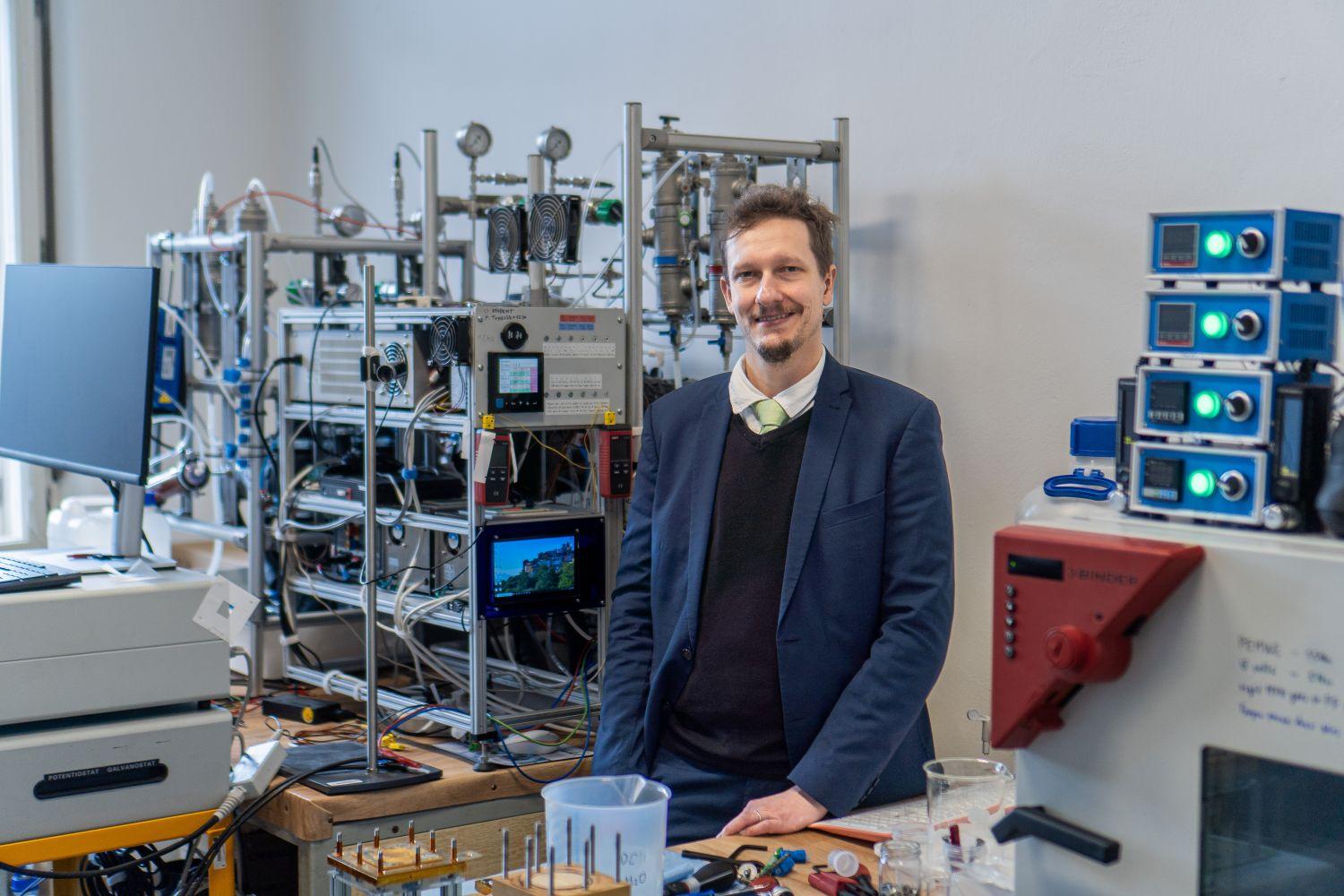
We have significantly expanded our infrastructure, so today we can examine the entire PEM electrolyzer chain, from individual components to entire layers and small assemblies. To study iridium catalysts, we use a rotating disk electrode and a series of small electrochemical cells in order to test their activity. For membranes, we have two special testing units in which we measure proton conductivity under various conditions; we can measure proton conductivity in situ with a flow of tempered water and with a flow of humidified gas.
In the laboratories, we have five testing stations for long-term testing of individual PEM electrolyzers and one more station for testing smaller assemblies. We monitor performance, stability, voltage changes, resistance development, and general degradation behaviour of cells and assemblies over time.
When you compare PEM electrolyzers made from recycled materials to standard materials, what differences in behaviour do you expect or even observe?
For IRION, we do not yet have recycled materials to test since the project has only just begun. However, in cooperation with German partners, we have already studied recycled membrane materials. The biggest difference is the internal structure of the membranes. A membrane cast from fresh ionomer has a different morphology than a membrane prepared by extrusion, and in recycled materials, there is also degradation of the ionomers that serve as precursors. This is reflected in the structure and properties of a final membrane.
A recycled membrane can therefore have reduced mechanical stability, lower conductivity, and lower separation properties. In practice, this is a fundamental problem, because in an electrolyzer, literally only a thin membrane with a thickness of approximately 50 to 150 micrometres separates hydrogen and oxygen. Therefore, it will be necessary to prove that even recycled materials can meet safety and operational requirements.
How difficult is it, using experimental data, to distinguish what the ionomer does from what the iridium catalyst does?
Theoretically, there are methods for distinguishing the influence of the ionomer and the catalyst on the performance of an electrolyzer, but they are analytically demanding. The basis for such methods is testing the individual components separately. For the iridium catalyst, we can measure its electrical conductivity; for example, in a compression cell for powders using direct current. Similarly, a sample of the ionomer can be prepared and its conductivity measured. This gives us the resistance separately for the catalyst and the ionomer.
We then measure the overall behaviour of the entire PEM cell with both DC and AC methods, and—from the impedance measurements—we are able to separate the individual anode, cathode, and membrane resistance contributions. Based on this analysis, we can further separate the individual resistance contributions of the ionomer and the catalyst at the anode. However, the entire analysis is complex and requires a lot of experience in interpreting the data.
How big a role does modelling play in your work? Do you use models for experiment design, data interpretation, or even for estimating scaling behaviour?
We use mathematical modelling quite often, although it is not formally separated into a separate IRION work package. We use simple models to determine the kinetic parameters of oxygen evolution catalysts and more advanced models to design the optimal geometry of test cells. In general, it can be said that modelling helps both in the interpretation of experiments and in the intensification of the device. For example, we can simulate water distribution, system behaviour at different current densities, oxygen removal, and water transport to the catalytic layer on the anode.
How does collaboration between academic and industrial partners work in IRION? What do industrial partners typically need from you and what do you need from them?
AIMPLAS from Spain is coordinating the project and STRATAGEM, the partner from Cyprus, is taking care of project management, external communication, and coordination among partners. There are large face-to-face meetings with all partners throughout the year as well as regular online meetings within individual work packages. In our case, collaboration is easy because our key partners (Safina and Fraunhofer ENAS in Chemnitz, Germany) are geographically and historically close to us and we have been cooperating with both of them for a long time.
Industrial partners mostly want precise data on materials and long-term degradation tests from us. They need to prove the performance and lifespan of materials in terms of specific numbers and operating hours. On the other hand, we need access to materials, especially recycled ones, and often also detailed parameters from these materials from industrial partners and this is sometimes sensitive information that companies do not like to share.
What is your personal role in IRION and what are you responsible for?
The project’s main UCT Prague coordinator is Professor Bouzek. However, I am responsible for all IRION experimental activities as well as coordination of reports and project outputs. I lead a small team within our department’s Technical Electrochemistry group that currently has three PhD students, three Master’s students, and two Bachelor’s students. The students mostly conduct characterization experiments related to the project.
How do you think the recycling of iridium and PFSA will affect the economy and the expansion of PEM electrolyzer use in the 10-15 year horizon? And what projects should ideally follow IRION?
Much depends on the evolution of Europe’s hydrogen strategy. In the Czech Republic, the current hydrogen strategy is quite ambitious, although we will see whether the new government will adjust it. There are already two Czech “hydrogen valleys” in the Ostrava and Ústí nad Labem regions where larger applications of PEM electrolyzers are being considered. In Germany, the role of hydrogen has been reduced somewhat recently, but there are still many applications that use PEM electrolysis and green hydrogen.
In general, the importance of recycling processes will grow. Over 1 gigawatt of installed PEM electrolyzer capacity for the production of green hydrogen is already in operation in the EU today, with the lifespan of individual devices usually at around 20-30 thousand hours and a maximum of 50 thousand hours. After the end of the lifespan of these devices, it will be necessary to purchase new ones and, at the same time, somehow deal with the old ones. If a reliable and high-quality membrane and iridium catalyst recycling process can be implemented, investment costs would be significantly reduced. For example, companies could offer long-term programs where a customer receives new (recycled) devices and returns the old ones for recycling.
Why are EU projects important?
In my opinion, EU projects are extremely important because they bring together a large number of partners, with often more than half of them being industrial partners. This allows us to establish new contacts for future grant funding and, at the same time, offers a great opportunity for students. Thanks to such projects, students can get internships in companies where the technology is actually developed and implemented. I myself had a similar experience during my doctoral studies and I consider it to have been very valuable.
The projects connect partners across Europe with whom we would otherwise have difficulty establishing cooperation such as the AIMPLAS polymer research technology centre or the research team at Saint Gobain. In our case, we were invited to IRION by German Fraunhofer ENAS, with whom we had previously successfully collaborated for three years on a project focused on the technology of producing catalytic layers for fuel cells.
Are you a complete team or are you looking for new students?
We are constantly looking for new students at all levels (Bachelor, Master, and PhD). All of our research topics are linked to ongoing grants and we try to involve students directly in these investigations. Students often perform measurements that go straight into project outputs and research reports. Doctoral students participate in project meetings, plan outputs, and get in touch with industrial partners. This way they can see first-hand what a technology looks like in practice, what the commercial sector currently deals with, and in what direction research needs to progress. Last but not least, students also make contacts for possible future employment after their doctoral studies.
What areas of experience are you interested in?
Our PEM group is quite problem-solving oriented and involves electrochemical engineering, design and construction of smaller units, and building PEM electrolyzers themselves in the laboratory. We would also welcome students with a focus on polymers because we work with ion exchange membranes as well as those knowledgeable about corrosion, since the degradation of the iridium catalyst is, in principle, a corrosion process.