







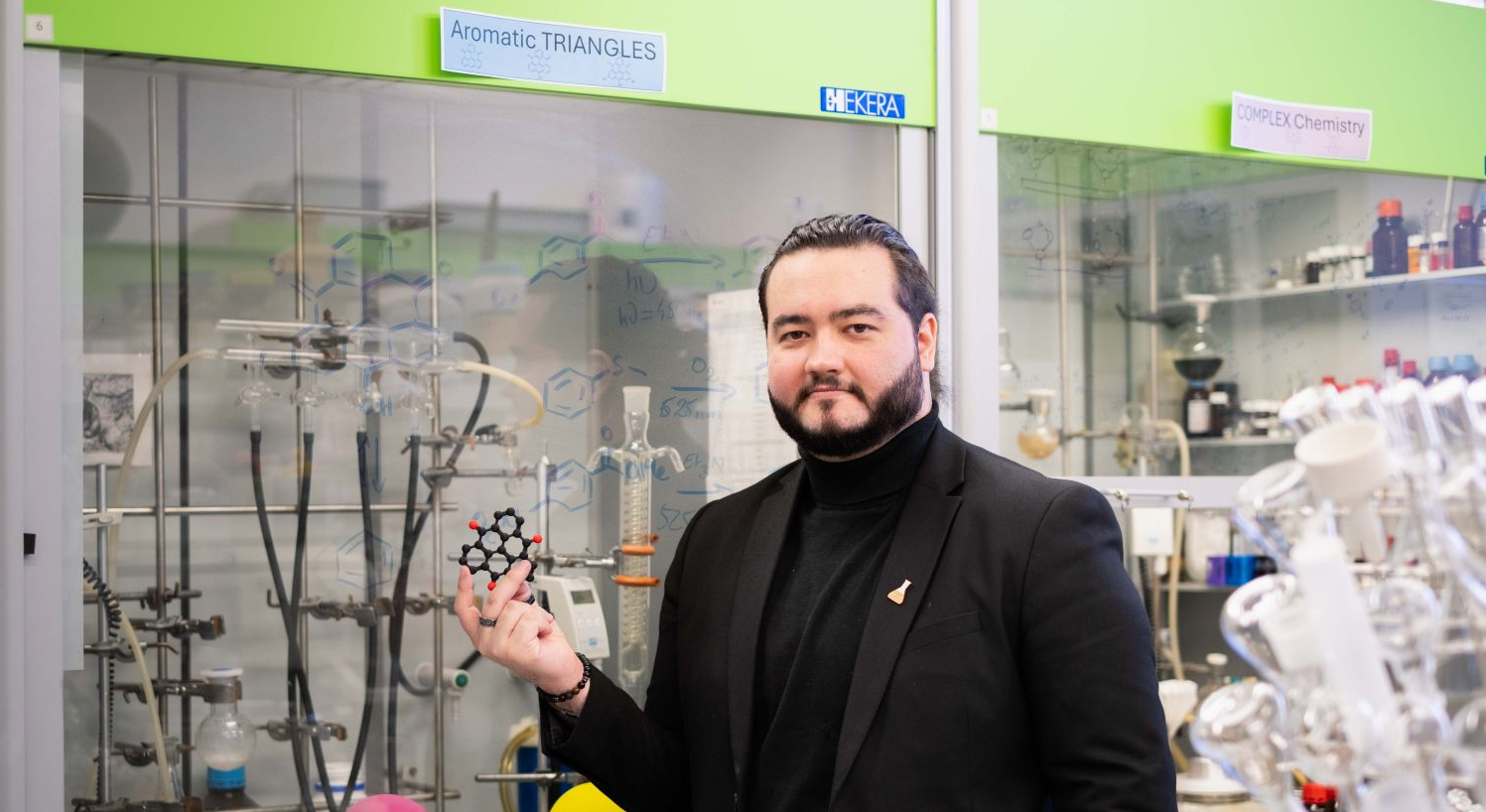
One vessel, three colours of light and three chemical reactions: UCT Prague research featured on the cover of Catalysis Science & Technology
A team of organic chemists from UCT Prague and collaborating institutions has introduced tri-oxo-triangulene as a multifunctional organic photocatalyst. By changing the wavelength of the light and the atmosphere in the reaction vessel, the researchers sequentially and selectively carried out three different chemical transformations in a single vessel. The study was published in Catalysis Science & Technology and featured on the front cover of the journal’s 19th issue.
In chemistry, light can serve not only as a source of energy but also as a precise tool for controlling chemical reactions. A research team with significant involvement from UCT Prague has now demonstrated that the organic molecule tri-oxo-triangulene can function as a multifunctional photocatalyst that utilises different colours of visible light.
The first author of the study Tri-oxo-triangulene is a polyfunctional catalyst of sequential red-green-blue photoredox systems is Killiann Heinz from the Department of Organic Chemistry at UCT Prague. The corresponding author is Petr Kovaříček, who also leads the research group. Scientists from other institutions, including the Institute of Organic Chemistry and Biochemistry of the Czech Academy of Sciences and the University of Zurich, also contributed to the research.
Photocatalysts use light energy to initiate or accelerate chemical reactions. Many commonly used systems rely on rare and expensive metals whose availability may be limited. Researchers are therefore looking for alternatives based on organic molecules that combine accessibility with the ability to catalyse different types of reactions.
In the new study, the authors tested tri-oxo-triangulene in three different photochemical reactions: the oxidation of sulfides to sulfoxides, the reduction of nitroaromatic compounds and the dehalogenation of 4-bromoacetophenone. They then demonstrated that these transformations could be carried out sequentially in a single vessel by slightly tuning the conditions of the reaction like atmosphere and/or the irradiation wavelength.
This arrangement is an example of a so-called one-pot synthesis. The individual reaction steps do not need to be performed separately, and the products do not have to be isolated between each step. Instead, the desired chemical processes can be triggered sequentially by changing the colour of the light. The results show that triangulene derivatives can serve not only as intriguing organic materials but also as multifunctional tools for photocatalysis. According to the authors, this is the first use of triangulene derivatives in photocatalysis.
“Usually, a photocatalyst is used to perform or accelerate one type of reaction. Here, we demonstrate that tri-oxo-triangulene can perform both oxidations and reductions, two opposite processes, and that we can control which reaction takes place by changing the irradiation wavelength or the atmosphere in the reaction vessel. This opens the door to more complex one-pot systems that could save time, reduce costs and make chemical processes more efficient,” says Killiann Heinz.
Killiann Heinz joined Petr Kovaříček’s research group in September 2022. His research focuses primarily on organic synthesis, supramolecular chemistry and photochemistry as well as optoelectronic materials.
The study was published in Catalysis Science & Technology, a journal published by the UK’s Royal Society of Chemistry. The journal covers both fundamental and technological aspects of catalysis, and the study was subsequently featured on the front cover of its 19th issue.
Research article: Tri-oxo-triangulene is a polyfunctional catalyst of sequential red-green-blue photoredox systems