






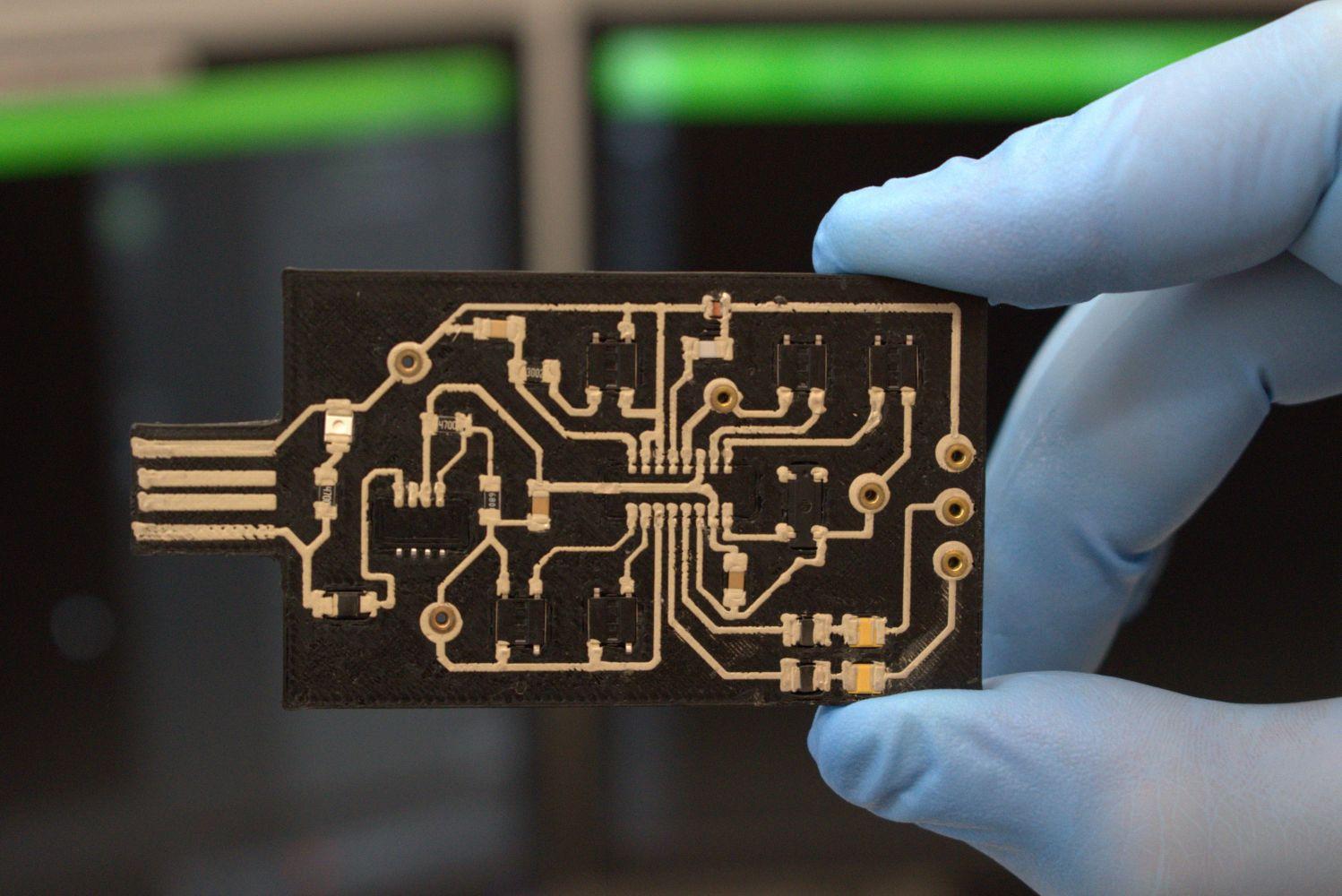
Researchers from FEE CTU and UCT Prague have produced electronics from vinyl record waste
Researchers from the Faculty of Electrical Engineering at the Czech Technical University in Prague (FEE CTU)) and the University of Chemistry and Technology, Prague (VŠCHT) have presented the results of more than two years of research focused on more environmentally friendly electronics manufacturing. As part of the SELECT project, they developed a technological process that uses waste plastic from vinyl record production to manufacture printed circuit boards via 3D printing. According to a life-cycle analysis, the new process reduces CO₂ emissions by up to 60 percent and lowers toxicity to humans by up to 90 percent compared to conventional manufacturing. Researchers are now working on further refining the technology and transferring it into practical use.
The production of printed circuit boards, which form the basis of virtually all electronics, is one of the most environmentally demanding parts of the electronics industry. It is associated with high consumption of chemicals, energy, and water, and the recycling of these components at the end of a product’s life is also problematic. In the Czech Republic alone, more than 150,000 tons of e-waste were collected in 2025, with printed circuit boards accounting for approximately six percent of that total.
A joint project by researchers from the Department of Electrical Engineering at the Faculty of Electrical Engineering (FEE) of the Czech Technical University in Prague (ČVUT) and the Institute of Polymers at the University of Chemistry and Technology, Prague (VŠCHT), focused specifically on this problem. The project was supported by the Technology Agency of the Czech Republic from 2024 to 2026 as part of the “Environment for Life” program and the National Recovery Plan.
“Our goal was to find a technology that would significantly reduce the use of toxic chemicals while enabling the use of plastic waste as a valuable raw material. After two years of development, we succeeded in creating a functional production process and verifying its environmental benefits,” says Dr. Petr Veselý, head of the FEE CTU research team.
Vinyl Record Waste as the Basis for Electronics
The UCT research team utilized PVC-based plastic waste generated during the production of vinyl records. The material was provided by the Czech company GZ Media, the world’s largest manufacturer of vinyl records.
“The polyvinyl chloride (PVC) used to manufacture vinyl records is unplasticized and, thanks to its high chlorine content, naturally self-extinguishing. This allowed us to create a material that meets safety requirements without the need to add other substances that are often environmentally problematic,” explains Dr. Alena Kadeřábková from the University of Chemistry and Technology, Prague.
From the waste material, researchers prepared a filament for 3D printing. Tests confirmed compliance with the requirements of the international UL-94 standard for self-extinguishability while maintaining mechanical properties comparable to those of commonly used materials for 3D printing. The result is protected by a utility model.
Electronics Free of Toxic Substances and with Lower Energy Consumption
Building on the recycled substrate, the FEL CTU team developed a manufacturing process for creating electronic circuits. The technology uses 3D printing and special conductive inks instead of traditional chemical processes.
“Another advantage of our process is the complete elimination of soldering or conductive bonding of components, which further reduces the energy intensity of production,” adds Dr. Petr Veselý.
3D printing of the electrically insulating substrate also allows for greater flexibility in the design of electronic circuits and the integration of components directly into the material structure. The researchers also conducted pilot tests to verify the long-term reliability of the connections and solved the challenge of interconnecting multiple layers for more complex electronic circuits.
60 percent fewer emissions, 90 percent lower toxicity
The project also included a detailed assessment of environmental impacts using the LCA (Life Cycle Assessment) methodology.
“It is clear that we will not install electronics made from waste plastic in an airplane or other equipment where reliability is a critical factor. On the other hand, most consumer electronics do not have such extreme requirements. It is precisely there that the potential for reducing environmental impacts can be very significant,” says Dr. Kateřina Bartošová from the Faculty of Electrical Engineering at CTU, who participated in the assessment.
The analysis showed that the new technology can reduce carbon dioxide emissions by up to 60 percent compared to traditional manufacturing. In the category of human toxicity, the reduction reaches up to 90 percent. Another advantage is the possibility of recycling the used plastic at the end of the device’s life cycle.
The solution does have its limitations for now. 3D printing technology does not yet allow for the production of the very fine structures needed for state-of-the-art chips, and researchers have not yet found a suitable alternative to silver-based conductive inks that would reduce the environmental footprint even further. The research team therefore plans to continue working on this topic even after the project ends and to focus on further technological and material improvements that would enable broader industrial use of sustainable electronics.