







From high school straight into sophomore year at UCT Prague and research into new drugs
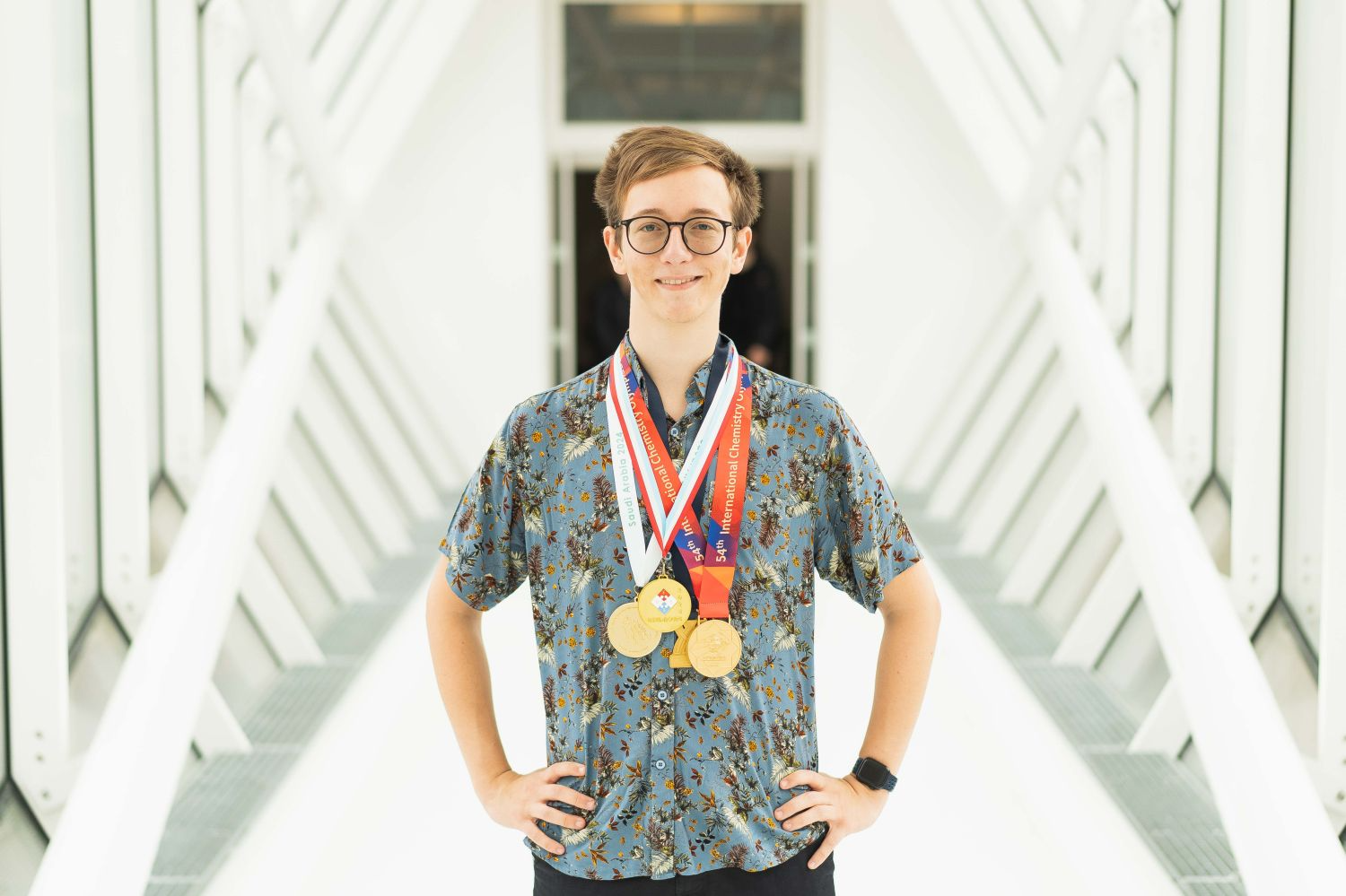
Václav Verner has won three gold medals at the International Chemistry Olympiad (IChO) and this year, he came in second place in the overall standings. He is a co-author of an article in the Journal of Medicinal Chemistry, works in a research group at the Institute of Organic Chemistry and Biochemistry of the Czech Academic of Sciences (IOCB Prague), and placed into the second year of UCT Prague studies directly from high school thanks to his studying in advance. Václav Verner was just awarded the Neuron Prize, as the first recipient in the Rising Star category, a new award for promising young scientists. This interview with Václav Verner shows that when chemistry starts to make sense, it becomes a highly addictive discipline.
You were introduced to chemical calculations through mathematics at an early age. What first interested you in chemistry?
It started completely innocently with the Chemistry Olympiad. We had one extremely committed chemistry teacher at the PORG Libeň high school.
In the sixth grade, after just a few months of in-class instruction, I caught my chemistry teacher’s attention (even though I knew almost nothing about chemistry at the time) and she persuaded me to compete in the local, qualifying round of the Chemistry Olympiad.
I remember asking her if I could bring with me my cheat sheet with inorganic nomenclature to the competition, that’s how bad I was! But I made it through the local round and advanced in the district qualifiers where I tied for third place I guess by pure chance. At the regional level, I placed almost last. Nevertheless, I stayed with chemistry from then on. So, in a way, I was thrown into the field, but today I am thankful to the Chemistry Olympiad for this.
You started studying at UCT Prague before you graduated. How did you manage to combine high school, courses at UCT Prague, and other activities?
The key was the schedule and the supportive nature of both schools. At PORG high school, we had three long days and two shorter ones. During the shorter days, PORG allowed me to take a few hours off, so I had time for attending courses at UCT Prague and for research at IOCB.
PORG didn’t adjust my study requirements, they just let me skip some attendance, mainly in subjects I had no problem with. But I still took all the tests and learned the required materials. As a result, I had two days when I could be in university classrooms or in the laboratory. I was given logistical freedom, not freedom from standard demands. Thus I could attend all sorts of parallel classes at UCT Prague and did not have a fixed schedule within prescribed seminar cycles. This allowed me to attend lectures and exercise sessions, also in the evenings, or to complete some course requirements separately.
How did your high school classmates and instructors feel about you?
We had a very competitive but science-oriented class. Many of my classmates were preparing for medical or technical fields. A community was formed in which we supported each other in moving forward instead of putting each other down.
Everyone treated me as part of the team, not as an exotic element. Teachers supported us and even let us prepare for competitions in some classes. They opened doors, but they didn’t ease the demands.
You participated in research into a substance against cryptococcosis at the IOCB laboratory. How did you get involved in this and what did you achieve?
After my first International Chemistry Olympiad (IChO), in August 2022, Prof. Jan Konvalinka approached me with an offer to come to the laboratory at IOCB. At that time, I was leaving for the US for a year, so we agreed to postpone my start by a year. In the end, in Summer 2023, I joined a group closely related to Jan Konvalinka's group, the IOCB Compound Library led by Pavel Šácha.
I have been working there on the pathogen Cryptococcus neoformans for the last two years. It is a pathogen that particularly threatens people with severely weakened immunity. It is known that it has a key enzyme, the blocking of which can stop its further spread. In the research group, we synthesized 624 molecules, tested them against this enzyme, and managed to obtain several very strong inhibitors, the main one of which has a 180 picomolar Ki (inhibition constant) and is orally bioavailable. I myself was involved primarily in the synthesis process since the entire final parallel synthesis process was my idea.
The result of these efforts was an article in the Journal of Medicinal Chemistry and creation of a candidate as a potential drug for further preclinical research. For me, this is proof that “Olympic” enthusiasm can actually lead to a project that can have real impact someday.
Which of your achievements means the most to you personally?
Scientifically, the IOCB project is certainly very satisfying: seeing the whole process from design to synthesis to testing and publication has been incredibly rewarding.
Among the competitions, the International Chemistry Olympiad meant the most. I have been there three times (2022, 2024, 2025), three times I won a gold medal (the gold medal is awarded to the top ten percent of participants) and this year, I placed second out of 354 participants from 90 countries in the absolute rankings. And I also really appreciated last year’s victory in the European Olympiad of Experimental Science (EOES), where it was a team victory, because a team of chemist-physicist-biologist competes together.
You have been repeatedly very successful at the International Chemistry Olympiad. How did you prepare?
It’s intensive. Preparatory problems are announced every year, with around thirty theoretical and ten practical problems. These preparatory problems indicate the topics that may appear at each year’s Olympiad, and their levels of difficulty range from high school level to the level of master's studies at a university.
Typically, I started preparing in February, when the national round takes place, then in June, my peak preparation period when I could easily spend four hours a day studying. Mainly by going through previous year problems, which is a kind of practical training. Among other things, the Czech Chemistry Olympiad is also a part of preparation. Every year they organize weekly theoretical and practical training camps in order to select representatives. But after the competition itself in July, there comes a phase when I just don’t want to see chemistry for a while. You are simply exhausted.
IChO is based on the idea that problems can be invented if you have the basics down. They never ask for factual information such as the colour of a complex or its melting point. Rather, they force you to calculate, draw structures, think, and reason.
What was more challenging, the theoretical or the practical parts?
A lot of people would tell you that I’m not the most skilled practitioner, that I sometimes spill something or that my TLC (thin layer chromatography) fails.
But this year, practice saved me. In the practical part, I had 38 out of 40 points, the best result this year. I excelled in the qualitative analyses and titrations and only lost a few points on the details. I also scored high in theory, but the combination of both moved me to second place overall.
At the top, tenths of a point are decisive, and in the absolute ranking, luck always plays a role.
How do you perceive the difference between “student” and “researcher” perspectives in chemistry?
In high school, a lot of people see chemistry as a list of things to memorize. But once you get past a certain threshold, you start to see that there’s structure and logic to it.
In theoretical research, it turns out that paper can withstand anything, but in the lab, half of the things don’t work. Also, when you visit a research lab for the first time as an inexperienced student, you are surrounded by people who have a lot of experience: PhD students, postdocs, group leaders. This forces you to think more deeply.
I think it’s crucial for students to connect theory with practice as soon as possible. Once you can imagine that there was a specific experiment behind the equations and formulas, it stops being so abstract.
You spent your second year of high school in the US. What did you like about the system there?
I really liked the connection between high schools and universities. For example, in the US, they have the AP system that allows high school students to study college-level subjects and take national exams that some universities recognize as equivalent to some of their courses.
They have quality materials for teachers and students, a clear structure. It opens up more avenues especially for people who might not otherwise decide to pursue study at a university level.
On the other hand, I found it unfortunate in the US that subjects like chemistry, physics, or biology are often only required for one year. Many students just go through everything to “survive” without taking anything away. In this respect, I think the Czech system, with its more systematic curriculum, is better.
In addition to my year at high school in the US, I had the opportunity to visit a college in England as part of the Experience Cambridge program, where current students invited us to campus for four days to soak up the atmosphere of university life. I learned there that although instruction is excellent, first-year students do not enter research laboratories at all and cannot participate in research. After considering all the options, I therefore decided to stay in the Czech Republic, at IOCB and UCT Prague, to have the best experience.
Thanks to your attending UCT Prague in high school, you placed straight into your second year at the university. How did this happen and how do you feel about it?
I was inspired by a friend from CTU Prague’s Department of Nuclear Chemistry, who had been taking lifelong learning courses since his sophomore year in high school. I wrote a long email to the UCT Prague Faculty of Chemical Engineering’s Dean’s office asking if something similar would be possible.
To my very pleasant surprise, I was invited to a personal meeting, and there, the question was no longer “if” but “how” to do it. We agreed on the subjects and the goal: to master the entire first year in three semesters. That was successful. I had to move the labs around because of my age, but everyone was accommodating.
From my experience, all the instructors including the admissions office have been very helpful so far, which I appreciate immensely, and for that, I owe them a big thank you.
“Chemistry can be invented, it’s not so much about memorization.” What do you mean by that?
Of course, there is a lot of information at the beginning that one has to learn, e.g. the structure of the atom, trends in the periodic table, basic reactions, VSEPR theory, and so on. It is not possible without it.
But once you have that foundation, most of the other stuff can be derived. You don’t have to know every reaction by heart. Once you understand the principles, you can use logic and calculations, a few formulas and constants. That makes chemistry a field that I can “invent for myself.”
Maybe that’s why I have less of a relationship with pure biology, where I think there’s more memorization. But I enjoy biochemistry, because it’s chemistry after all. It has a system.
How would you describe “chemical intuition”?
It’s the ability to look at a problem and see something in it that you’ve seen before. When you master the mechanisms, the types of problems, the reaction schemes, you can say to a new example: “This is a combination of these three things, all of which I actually already know.”
This is crucial in Olympiads, because there are a limited number of problem types. Once you’ve gone through them, nothing will surprise you fundamentally. In organic chemistry, on which I’m currently focused, it’s similar: a new reaction often looks like just a variation on a familiar theme. They’re like puzzles.
You have a connection to robotics: you’re involved in Chemiklání, a team competition for high school students. chemistrHow are these activities related to chemistry?
Robotics was initially more of a contrast for me: mechanics, programming, something different from chemistry. Now I am returning to it as a mentor for the high school robotics team R.U.R. at PORG high school, while the technical skills also come in handy at IOCB, where we deal with automated peptide synthesis.
I gradually replaced tutoring with the role of the chief Czech editor of Chemiklání. I create, collect, and edit assignments and, together with a few other people, help prepare the next year competition. I see it as a way of giving back to what the competitions have given me.
What about your “non-scientific” interests?
I swam competitively for a long time, but now I swim more recreationally. I played the piano, flute, and trumpet, but I return to the piano the most. Chemistry competes with all that; there is not an infinite amount of time.
What message would you send to high school students who are thinking about taking university-level classes while still in high school or about “trying university” early?
If you seriously want to go the chemistry route, it makes sense, even if you don’t want to finish the entire year right away. Just going to lectures and lab exercise sessions, being able to try “taking an exam.” talking to instructors, and soaking up the atmosphere of a university is a huge advantage and experience.
Attending classes at the university while you’re still in high school can help you see if chemistry and a particular university are right for you. You’ll discover the difference between the strict high school curriculum and university, where no one is constantly watching you. And if you really enjoy chemistry, it’s a shame to wait if you can start earlier.